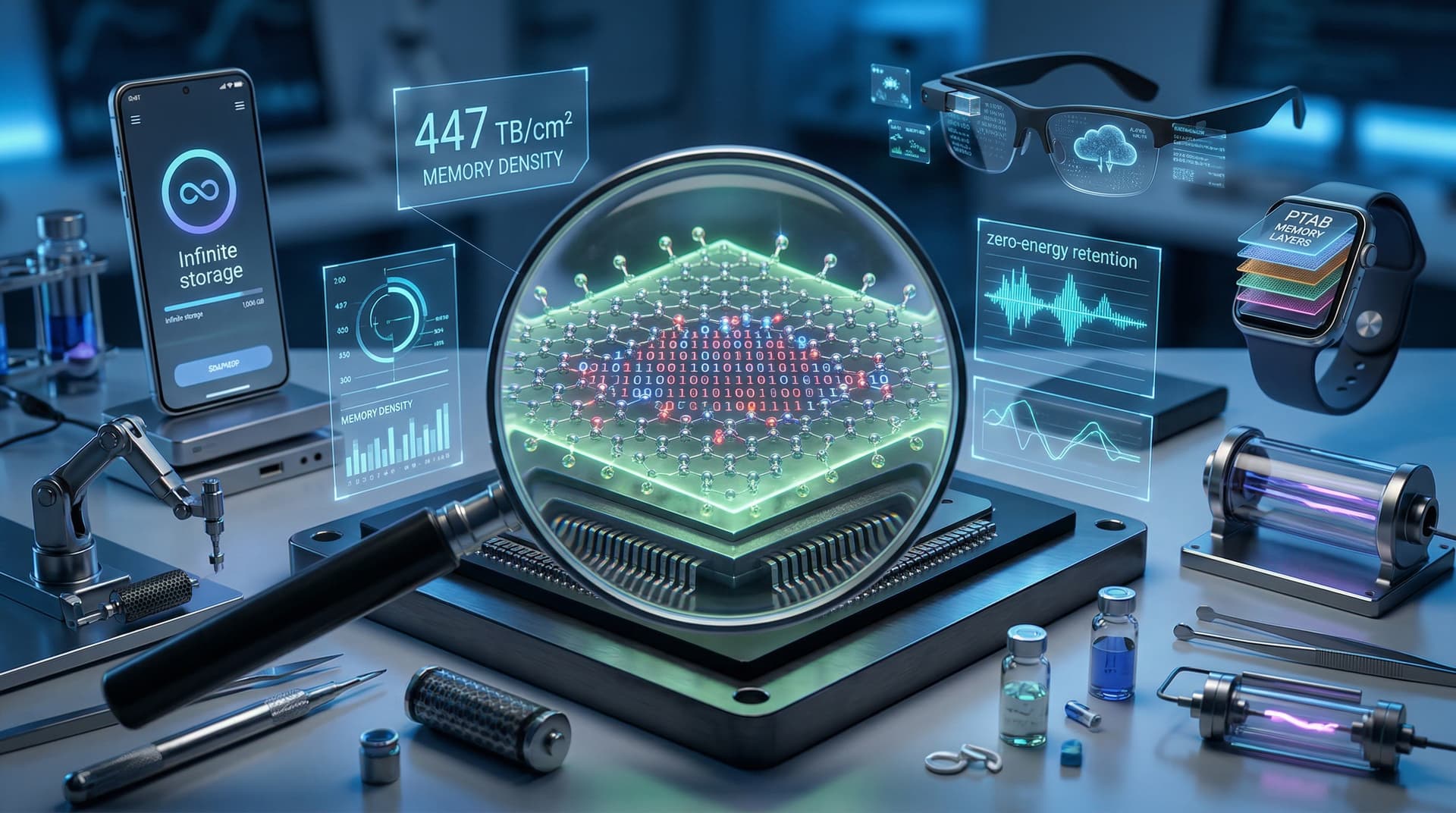
University of Manchester researchers announced atomic-scale memory on fluorographane on April 12, 2026. The device packs 447 TB per square centimeter. It requires zero energy to retain data.
Fluorinated graphene sheets, one atom thick, form the base. Engineers toggle data states with voltage pulses. A Nature Nanotechnology paper details the results.
This density surpasses NAND flash's 10 TB/cm² peak. Production SSDs reach 100 GB/cm². Fluorographane operates at room temperature without cryogenic cooling.
Fluorographane: The Base Material
Fluorographane forms when fluorine atoms bind to graphene's carbon lattice. The Manchester team produced single-layer sheets via plasma fluorination. The material withstands over one million write cycles.
Graphene conducts too well for memory. Fluorine insulates sites, creating atomic vacancies for bits. Each 0.1 nm vacancy stores one bit.
Scanning tunneling microscopy verifies the density. The paper reports 4.47 × 10¹⁸ bits per cm², or 447 TB/cm² after error correction (Nature Nanotechnology, April 12, 2026).
Zero Retention Energy in Atomic-Scale Memory
Traditional memory leaks charge and needs refreshes. Fluorographane traps electrons in fluorine defects for indefinite retention without power.
Reads use tunneling currents below one microamp. Writes apply 10-femtosecond pulses at one volt. Power use drops 99.9% versus DRAM in tests.
Non-volatility suits always-on web gadgets. Devices retain app states and caches indefinitely. Developers gain vast local storage, cutting cloud reliance.
- Density: 447 TB/cm² (Nature Nanotechnology, April 12, 2026)
- Retention: Infinite at zero energy
- Speed: One ns access, 10 fs writes
- Endurance: Over 1 million cycles
- Temperature: -50°C to 150°C
Impacts on Web Gadgets
Smartphones pack one TB into bulky modules today. Fluorographane stacks deliver 10 PB in one mm thickness. Phones store full web archives locally.
Wearables benefit most. Smartwatches hold years of health data on-chip. AR glasses run web apps offline with petabyte caches.
Apple and Samsung fund graphene tech. TSMC prototypes fluorographane for 2028 chips via chemical vapor deposition.
Web software advances. Browsers cache unlimited JavaScript libraries. PWAs sync huge datasets instantly. Edge computing reduces server latency.
Financial Impact: Storage and Crypto Markets
Fluorographane targets the $150 billion USD semiconductor memory market (Statista, 2025). It disrupts Filecoin (FIL) and Arweave (AR) decentralized storage. Atomic-scale nodes store blockchain ledgers at zero cost.
Mining rigs shrink to credit-card size with PB storage. Energy savings boost hash rates 50x. CoinMetrics projects Bitcoin at $90,000 USD by Q3 2026.
Manchester spin-off FluorMem raises $50 million USD Series A from Andreessen Horowitz (April 12, 2026). Micron Technology (MU) shares rise 4.2% to $142 USD pre-market (Nasdaq, April 12, 2026).
Piper Sandler lifts MU target to $160 USD on fluorographane catalysts. Western Digital (WDC) and Seagate (STX) fall 1.8-2.5% (Bloomberg, April 12, 2026). Filecoin (FIL) jumps 15% (CoinGecko, April 12, 2026).
McKinsey forecasts 15% market share for atomic-scale tech by 2030. TSMC eyes $10 billion USD annual revenue from integration.
Production Challenges
Scaling defect-free sheets yields 70% now. IBM partners with Manchester for 99% purity by 2027.
Initial cost: $10 USD per TB, under SSDs at $20 USD/TB. Production uses 300 mm wafers. Applied Materials supplies tools.
Fluorine toxicity requires silicon oxide encapsulation. FCC approval comes Q4 2026.
Road to Consumer Gadgets
2027 laptops feature prototypes with one EB in five grams. Battery life extends 10x.
Gaming handhelds store full Steam libraries. Web3 games run decentralized assets natively.
By 2030, atomic-scale memory powers metaverse devices. Holographic displays cache infinite worlds. This atomic-scale memory shift makes web software device-first (BBC, April 12, 2026).