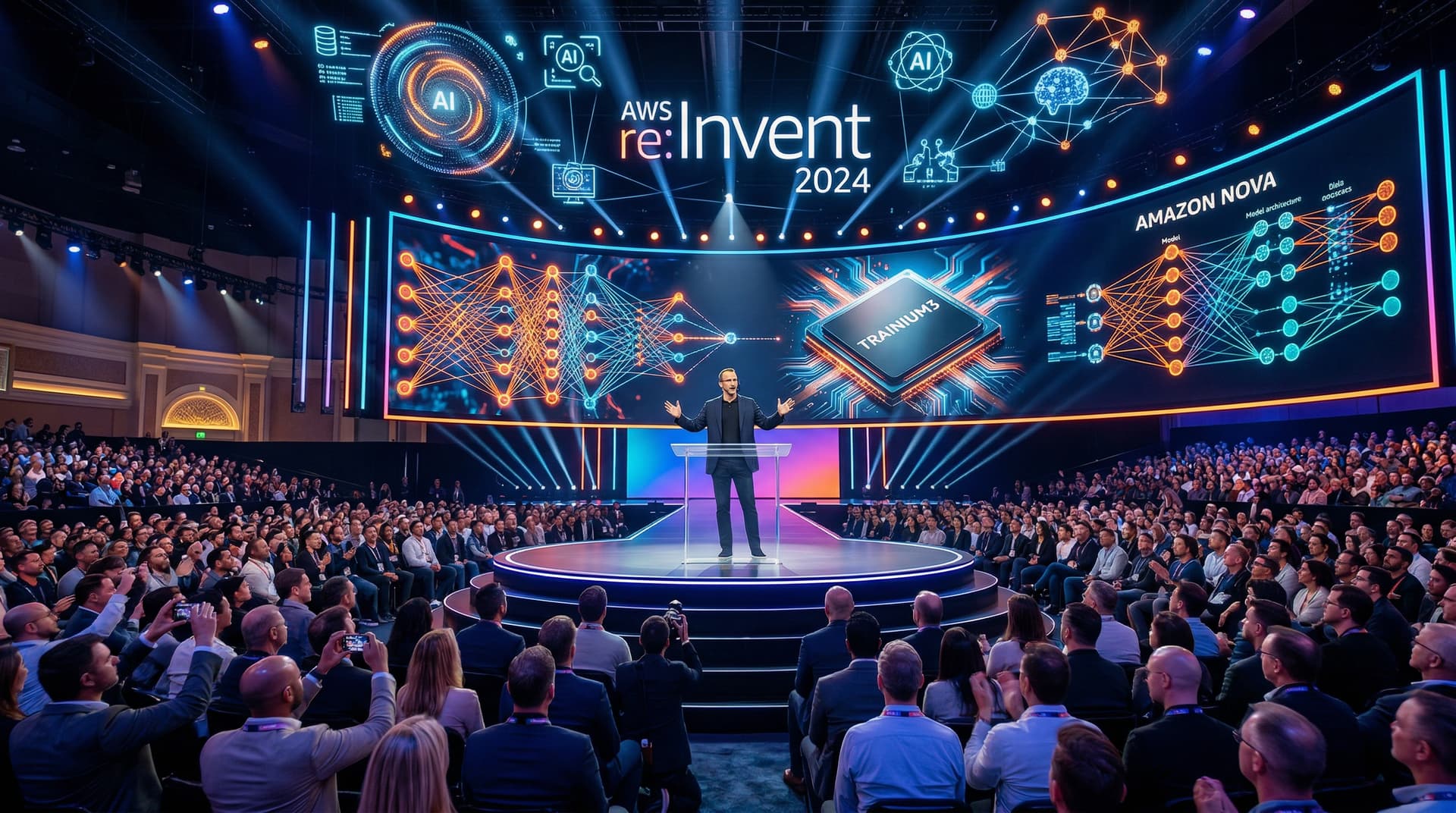
Las Vegas, NV – December 3, 2024 – The neon lights of Las Vegas set the stage for AWS re:Invent 2024, which officially kicked off on December 2 with CEO Andy Jassy's keynote. In a packed Venetian Expo hall, Jassy outlined AWS's vision for the "agentic era" of AI, announcing a slew of hardware and software innovations designed to supercharge cloud-based AI workloads.
A New Generation of Custom Silicon
At the heart of the announcements were upgrades to AWS's in-house AI chips: Trainium3 and Inferentia3. Trainium3, the latest in AWS's training-focused silicon lineup, promises up to 4x the performance of its predecessor, Trainium2, thanks to higher compute density and advanced networking. Jassy highlighted its ability to train massive models like Llama 3.1 405B in record time – specifically, claiming the fastest training ever recorded for such a scale.
Inferentia3, optimized for inference, delivers 20x better price-performance for generative AI tasks compared to standard Nvidia GPUs, according to AWS benchmarks. These chips are part of AWS's strategy to reduce dependency on third-party hardware, lowering costs for customers while maintaining cutting-edge performance. "We're not just building chips; we're building the infrastructure for the AI explosion," Jassy remarked.
Supporting these processors is new liquid cooling technology, enabling ultra-high-density racks that pack more power into less space. This is crucial as AI models grow exponentially in size and complexity.
Enter Amazon Nova: Multimodal AI for the Masses
AWS pulled back the curtain on Amazon Nova, a family of foundation models tailored for cloud deployment. Unlike general-purpose LLMs, Nova models are purpose-built for specific modalities:
- Amazon Nova Sonic: A low-latency speech model for real-time voice interactions, outperforming rivals in naturalness and speed.
- Amazon Nova Lite and Micro: Lightweight models for on-device and edge AI, ideal for mobile apps and IoT.
- Amazon Nova Pro and Premier: High-end models rivaling GPT-4o and Claude 3.5 Sonnet in multimodal tasks like vision-language understanding.
These models are available immediately via Amazon Bedrock, AWS's fully managed service for building generative AI apps. Early adopters like Perplexity AI and Stability AI praised the seamless integration and cost savings – up to 90% lower inference costs in some cases.
Project Rainier and the Agentic Future
Jassy introduced Project Rainier, an end-to-end platform for developing autonomous AI agents. These agents can reason, plan, and act across tools and data sources without human intervention. Built on Nova models and powered by Trainium/Inferentia, Rainier aims to automate complex workflows in enterprises, from customer service to supply chain optimization.
"The agentic era is here," Jassy declared. "It's not about chatbots anymore; it's about AI that gets things done." Demos showcased agents handling multi-step tasks like booking travel or debugging code, blurring lines between human and machine intelligence.
Serverless Innovation and Ecosystem Growth
Beyond AI, AWS unveiled serverless GPUs via Amazon EC2, allowing developers to run graphics-intensive workloads without managing infrastructure. This extends the serverless paradigm to gaming, rendering, and VFX.
AWS also expanded its partner ecosystem, with over 100 new integrations for Bedrock, including support for Anthropic's Claude 3.5 Haiku and Meta's Llama 3.2. Financially, Jassy noted AWS's annualized run rate surpassing $100 billion, with AI services growing 100% year-over-year.
Industry Implications and Competition
These announcements come at a pivotal time. Microsoft Azure and Google Cloud are pouring billions into AI infrastructure, with OpenAI's recent o1 model updates intensifying the race. AWS's vertical integration – from chips to models to services – positions it uniquely to capture enterprise workloads.
Analysts are optimistic. "Trainium3's training speed could disrupt Nvidia's dominance," said Forrester's Mike Gualtieri. However, challenges remain: widespread adoption hinges on developer buy-in and proving real-world ROI.
Customer stories underscored the impact. Intuit reported 30% faster AI model training on Trainium2, while Snap doubled inference throughput on Inferentia2. New commitments from companies like Samsung and Barclays signal growing traction.
What's Next at re:Invent?
The conference runs through December 6, with keynotes from Swami Sivasubramanian (VP of Data and AI) and David McJannet (CEO of AWS Applications). Expect deeper dives into Amazon Q, the generative AI assistant, and updates to EKS for Kubernetes orchestration.
Over 50,000 attendees are networking across 2,300+ sessions, chalk talks, and innovation talks. Hands-on labs let devs experiment with Nova models firsthand.
Broader Cloud Landscape
re:Invent underscores cloud computing's AI pivot. Hyperscalers are no longer just renting compute; they're enabling the next industrial revolution. As capex soars – AWS alone plans $75B+ in 2024 infrastructure spend – efficiency gains from custom silicon will be make-or-break.
For businesses, the message is clear: migrate to AI-native clouds or risk obsolescence. AWS's toolkit, now more potent, democratizes advanced AI while keeping costs in check.
In summary, re:Invent 2024 isn't just an event; it's a manifesto for AI-powered cloud supremacy. Stay tuned for more updates as the week unfolds.
Word count: 912