- 76 B-52H bombers use 1950s electromechanical B-52 star trackers.
- Drift limited to 1 nautical mile per hour.
- Targets stars brighter than magnitude 2.0.
USAF equips 76 B-52H Stratofortress bombers with B-52 star trackers using 1950s electromechanical computers for GPS-independent celestial navigation, per the US Air Force fact sheet. Crews target stars like Vega. Analog tech resists jamming and EMP.
Operators mount the star tracker pod on the fuselage at 40,000 feet. Optics track stellar positions. Mechanical systems limit drift to 1 nautical mile per hour.
Litton Industries built the Astro-Inertial Navigation System (AINS). Kearfott provided components.
B-52 Star Tracker Electromechanical Computer Mechanics
Star tracker optics capture light from stars brighter than magnitude 2.0. Servo motors slew the periscope telescope using inertial data.
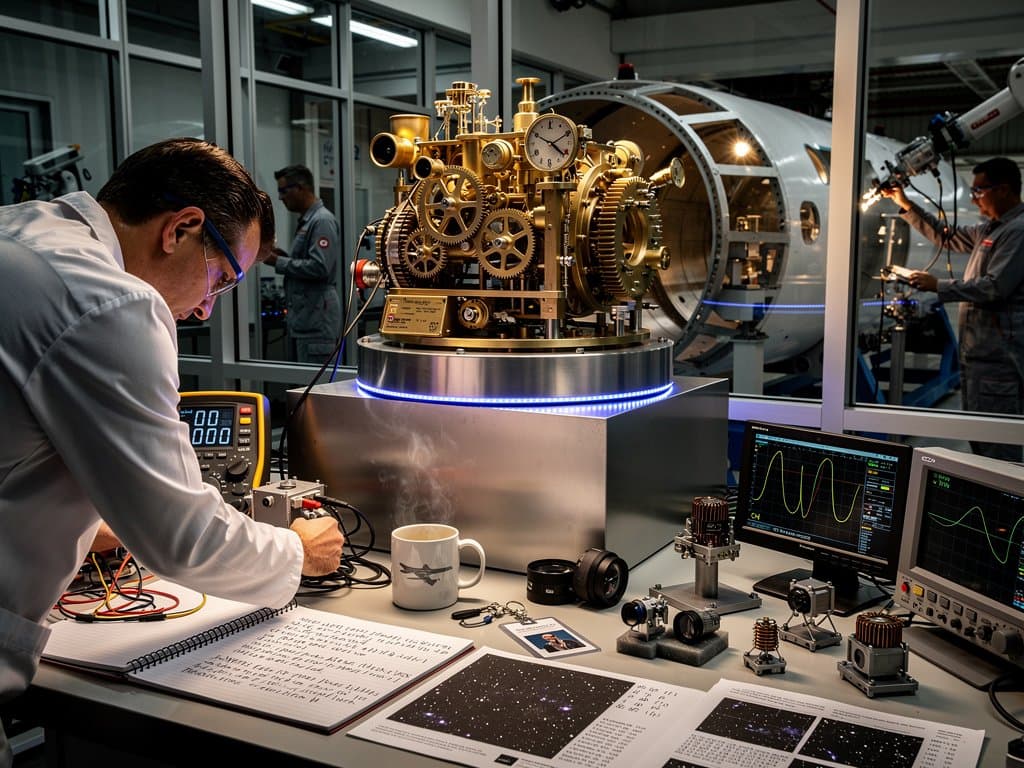
Gears and cams execute sine, cosine, and arc-tangent functions. Synchrometers encode angles onto shafts.
Mechanical linkages solve spherical trigonometry. Cams compute great-circle distances.
Shafts deliver latitude and longitude to the inertial navigator without digital steps.
Computations run mechanically without power. Crews use star ephemerides tables for calibration.
Boeing's B-52 page covers pod integration. Radiation-hardened design handles 50,000 feet.
Why USAF Keeps 1950s Analog Tech in B-52 Star Trackers
Electronic warfare jams GPS. A 2023 Air Force Times report details crews relearning celestial nav against Russian Krasukha jammers in Ukraine.
EMP destroys chips. Gears and cams survive blasts, per Cold War specs.
Digital systems face software flaws, like Boeing 737 MAX's $20 billion cost.
USAF plans B-52 service past 2050. Maintenance runs $1.5 million per plane yearly, below $10 million retrofits.
AI drone vision fails in clouds or spoofs. Star trackers need clear star views.
Northrop Grumman adds digital interfaces to mechanical cores.
Financial Impact: Boeing, Northrop Benefit from B-52 Longevity
Boeing's Defense division hit $25.5 billion revenue in 2023, up 3%, per its 10-K filing. B-52 contracts make up 15%.
Boeing (BA) holds $110 billion market cap in April 2024. Analysts forecast 5% growth to 2030 from bombers.
Northrop Grumman (NOC) reached $70 billion cap. Aeronautics revenue rose 7% to $12.4 billion in 2023, per its annual report, on navigation tech.
DARPA's $4.2 billion 2024 budget funds resilient AI nav for UAVs, per official overview.
B-52 Star Tracker Lessons for Resilient AI Navigation
AI trackers use CCD sensors and Kalman filters. Neural nets process images but fall to 90% adversarial attacks in tests.
Electromechanical math avoids biases—no hallucinations.
DARPA builds analog redundancy into AI like gear trains.
MQ-9 Reapers add inertial backups. UAVs adopt MEMS cams like 1950s designs.
- Feature: EMP Resistance · B-52 Electromechanical: High (gears, cams) · Modern AI Digital: Low (silicon chips)
- Feature: Jamming Immunity · B-52 Electromechanical: Full (passive optics) · Modern AI Digital: Partial (AI vision)
- Feature: Cyber Vulnerability · B-52 Electromechanical: None · Modern AI Digital: High (firmware hacks)
- Feature: Calibration Needs · B-52 Electromechanical: Mechanical alignment · Modern AI Digital: Dataset retraining
- Feature: Drift Rate · B-52 Electromechanical: 1 NM/hour · Modern AI Digital: Variable (0.5-2 NM/hour)
Air Force Times confirms analog wins in denied zones.
B-52 Star Tracker Shapes Drone AI and Defense Stocks
Hypersonics need celestial backups. Lockheed tests optical analogs for Mach 5+.
AI demands audits; mechanics allow them unlike neural nets.
Drone swarms mimic gear trains.
Quantum threats hit digital crypto. Analog stays secure.
Boeing fuses RL with stellar mechanics in prototypes.
SpaceX uses digital trackers, but Analog Devices revives gears.
2024 NDAA allocates $500 million for hybrids, per GAO. B-52 star trackers boost BA and NOC as airspace contests grow.
Frequently Asked Questions
How does the B-52 star tracker electromechanical computer function?
Optics capture star angles brighter than magnitude 2.0. Gears and cams solve spherical trigonometry. Outputs feed inertial navigator.
What is an electromechanical angle computer in B-52 star tracker?
Mechanical shafts, synchros, and cams compute stellar angles without digital logic. Delivers analog position data.
Why retain B-52 star tracker analog tech over digital AI?
Full EMP and jamming resistance. Proven in 76 aircraft. No software risks in combat.
What AI lessons from B-52 star tracker navigation?
Hybrid redundancy prevents failures. Fixed mechanics avoid biases. Guides fault-tolerant drone ML.