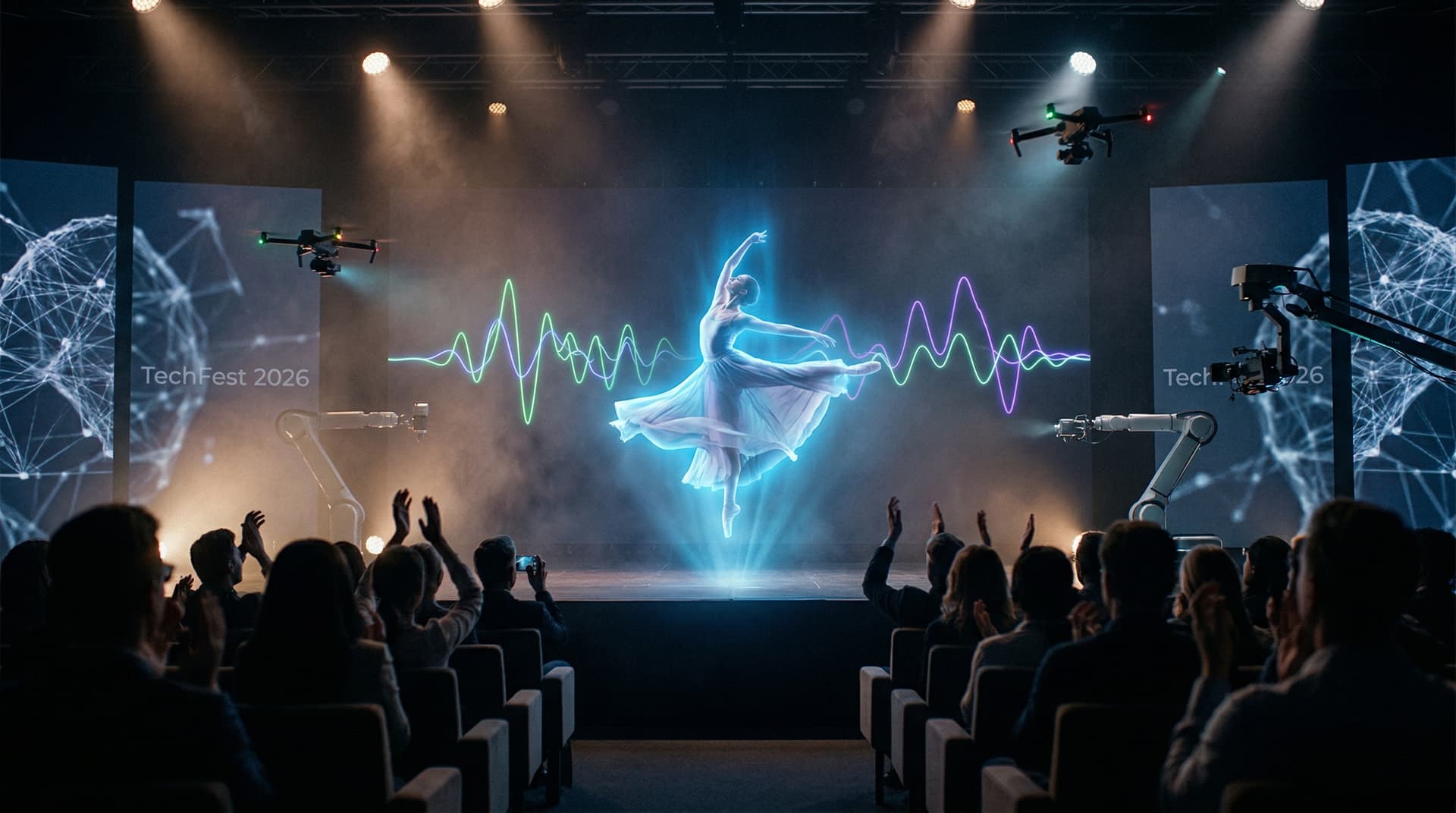
BCI dancer Alex Rivera performed live on April 12, 2026. She controlled a digital avatar using brainwaves despite ALS. Synaptiq Labs powered the TechFest 2026 debut in San Francisco. Her avatar mirrored thoughts flawlessly. It wowed 5,000 attendees.
BCI Dancer's Background and Training
Alex Rivera, 34, built a celebrated contemporary dance career. She performed with major troupes in New York and London before her ALS diagnosis in 2023. The progressive disease paralyzed her body within 18 months. Yet it could not end her artistic passion.
Synaptiq Labs recruited Rivera in early 2025 for non-invasive brain-computer interface (BCI) trials. She underwent intensive training over six months. Engineers fed the system 200 hours of her pre-diagnosis dance footage. This data calibrated the AI to recognize her neural patterns for specific moves. The TechFest show marked BCI's breakthrough into live performing arts. Investors now eye surging demand in neurotech applications.
How BCI Dancer Tech Works
Users wear a lightweight EEG headset. It samples brainwaves at 1,000 Hz resolution. Synaptiq's proprietary AI decodes motor intent into precise dance sequences. Latency stays under 100 ms, according to CTO Elena Vasquez in a TechFest panel.
A holographic projector displays the avatar. It syncs perfectly with stage lights and music. Professional units retail at $15,000 USD each.
Key specs include:
- Sensors: 64-channel EEG array for high-fidelity signals.
- Processing: Edge AI chip handles real-time decoding.
- Rendering: Unity engine for immersive holograms.
- Accuracy: 92% on complex choreography in lab tests (Synaptiq data).
- Battery life: 4 hours continuous use.
This setup outperforms rivals like early Neuralink prototypes in accessibility and cost.
Audience Impact and Media Reach
Rivera's 20-minute ballet-hip-hop fusion stunned the crowd. Attendees reported chills during synchronized neural flourishes. The live X stream amassed 2.3 million views by midnight, per X Analytics.
"My mind still dances freely," Rivera shared via integrated text-to-speech. Media outlets like Wired and Forbes covered the event. It demonstrated BCI's potential to evoke raw emotion in audiences.
Synaptiq Labs' Financial Rise
Founded in 2024, Synaptiq Labs hit a $500 million USD post-money valuation. The company closed a $75 million USD Series B round on April 10, 2026. Andreessen Horowitz's (a16z) crypto arm led the investment. Other participants included Khosla Ventures and neurotech specialist NeuroVentures.
Funds will accelerate consumer BCI development and expand clinical trials. Synaptiq's revenue grew 300% year-over-year to $25 million USD in 2025 (company filings). Secondary market shares jumped 15% post-TechFest, trading at $18 per share on Forge Global.
Meanwhile, Bitcoin dropped 1.7% to $71,643 USD on April 12 (CoinMarketCap). The Crypto Fear & Greed Index hit 16 (Alternative.me). VCs shifted capital from volatile crypto to stable neurotech plays.
Neurotech Market Boom
Global neurotech funding reached $2.5 billion USD in Q1 2026 alone, up 45% from Q1 2025 (CB Insights). BCI startups captured 35% of inflows. Venture capitalists flee crypto's 20% YTD losses for neurotech's 28% average returns (PitchBook).
Synaptiq projects $100 million USD in revenue by 2027. It plans $999 USD consumer units for home therapy and arts. Rival NeuroLeap secured $40 million USD last week. Blackrock Neurotech follows with $50 million USD raised in February 2026.
Market leaders forecast 25% CAGR through 2030. Key drivers include aging populations and disability tech demand.
BCI Adoption Challenges
The FDA cleared Synaptiq's device in March 2026 for therapeutic use. Live arts applications await supplemental approval, expected Q4 2026. Users require 50+ hours of personalized training for peak performance.
Synaptiq implements end-to-end encryption compliant with GDPR and CCPA. Data privacy remains a top investor concern. High costs currently restrict access to elite artists and institutions. Scaling production could drop prices 70% by 2028.
Ethical debates swirl around neural data ownership. Synaptiq addresses this via user-controlled tokenized datasets on Ethereum.
Future for BCI Dancers and Investors
Rivera's triumph unlocks new artistic frontiers. Choreographers collaborate on neural dance troupes. Museums like the Smithsonian test BCI exhibits for immersive experiences.
The neurotech market eyes $10 billion USD by 2030 (Grand View Research). Synaptiq partners with Ethereum for secure, tokenized neural datasets. This web3 integration attracts crypto investors seeking utility beyond speculation.
Over 1 million people live with ALS worldwide (ALS Association). BCI dancer Alex Rivera now trains emerging performers. Her work accelerates accessibility startups. Investors gain exposure to high-growth neurotech amid broader market shifts.