
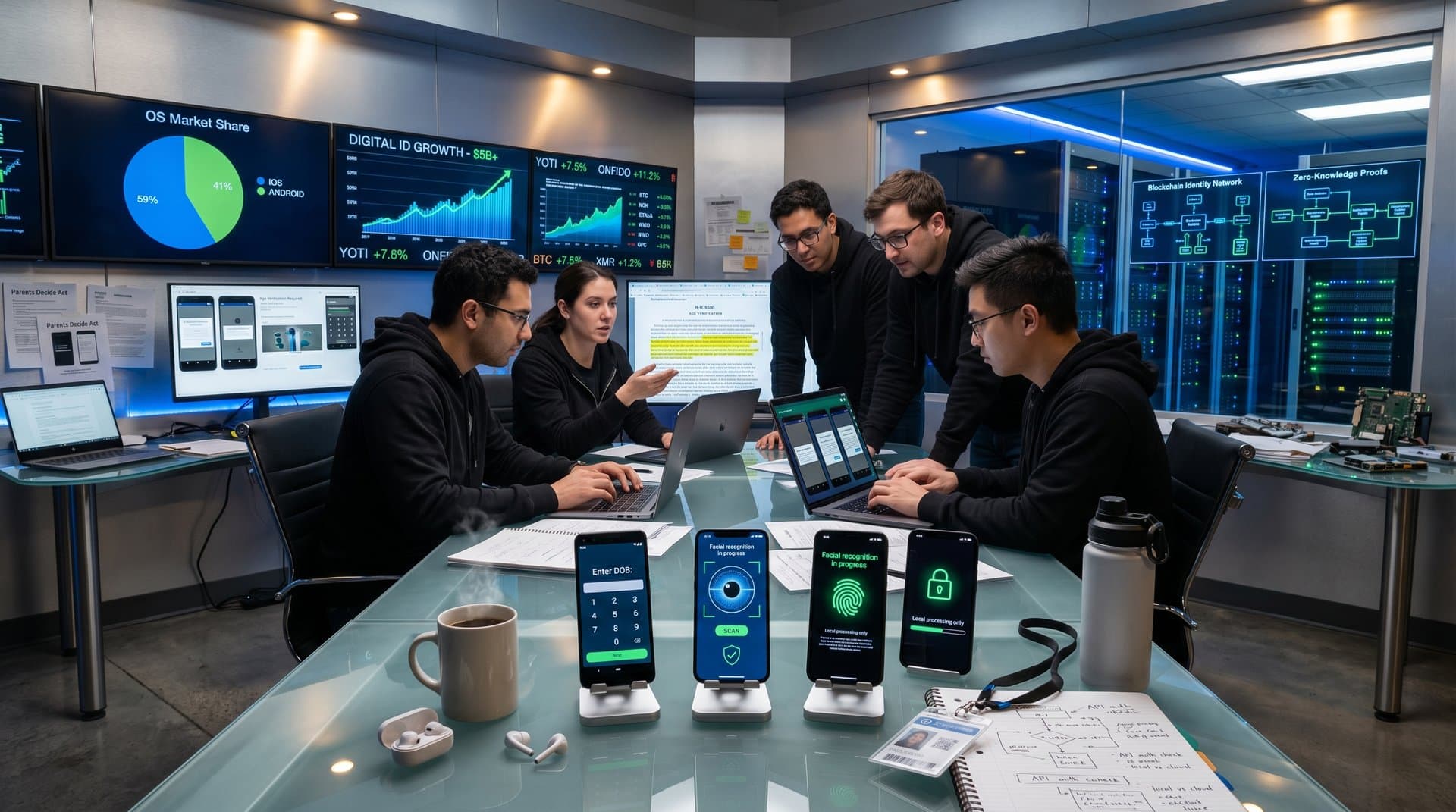
- H.R. 8250 mandates on-device age verification for 300M U.S. mobile users.
- Apple (59%) and Android (41%) add DOB prompts pre-app install.
- Privacy startups eye $5B market with biometrics and zero-knowledge proofs.
Rep. Josh Gottheimer (D-NJ) introduced H.R. 8250, the Parents Decide Act, on April 13, 2026. The bill mandates on-device age verification via date-of-birth entry for 300 million U.S. mobile users on Apple and Google platforms. Section 2(a)(1) enforces this at the OS level before app installs Congress.gov bill text.
Gottheimer warned of bypass risks at an April 2 Ridgewood conference. Children fake birthdays to access apps. Reclaim The Net quotes him: “Children are able to bypass age requirements by entering a different birthday.” The FTC oversees enforcement per Section 2(d)(1)(B) FTC privacy guidance.
Apple 59% and Android 41% Shares Hit by H.R. 8250
Apple holds 59% U.S. mobile OS share; Android claims 41%, per StatCounter April 2026 data StatCounter. H.R. 8250 demands OS-level birth date prompts before downloads. Section 2(a)(3) offers developers secure APIs for age data.
Web platforms relying on self-reported ages face disruption. On-device age verification stores data locally for privacy. Gottheimer noted: “The internet grows more treacherous for kids daily.”
Web Apps Blocked from 25M U.S. Minors by OS Age Gates
Social and web apps tie into mobile OS. H.R. 8250 blocks underage access pre-download. U.S. minors number 25 million active mobile users, per 2025 Census estimates U.S. Census.
Startups build biometrics via Apple's Neural Engine and zero-knowledge proofs. Data stays on-device. FTC fines hit $52 million in recent COPPA cases FTC COPPA enforcement.
| OS Provider | U.S. Share | H.R. 8250 Mandate |
|---|---|---|
| Apple iOS | 59% | DOB prompt pre-install |
| Google Android | 41% | Secure age APIs for devs |
Privacy-Tech Startups Eye $5B Market by 2028
Gartner projects $5 billion digital identity market by 2028 Gartner. Solutions align with Apple's Private Computation Apple and Google's Private Compute Core.
Yoti raised $25 million in Series E March 2026 Crunchbase. Onfido, at $2.5 billion valuation, uses zero-knowledge proofs. Web3 firms advance decentralized IDs.
VC in privacy tools rose 15% to $1.2 billion in Q1 2026 PitchBook.
Crypto Rallies on H.R. 8250 Privacy Demand
Privacy assets surge. Bitcoin hit $75,815, up 1.7% ($1.52T cap). Ethereum reached $2,360, up 1.2% ($285B cap). Solana jumped 4.2% to $88.65 ($51B cap). Monero rose 5% CoinMarketCap historical.
XRP gained 2.6% to $1.45 ($89B cap); DOGE climbed 3% to $0.10 ($15B cap). Decentralized IDs gain traction. Platforms lose $2.5 billion ad revenue from minor bans eMarketer.
Investors Eye Identity Firms on H.R. 8250 Passage
House targets Q3 2026 vote; FTC rules by Q4. Legacy platforms comply via APIs; startups see valuation spikes.
Key players like Yoti and Onfido lead amid the 300 million-user on-device age verification shift. Markets price in impacts, with privacy outperforming through 2028.
Frequently Asked Questions
What does H.R. 8250 require for on-device age verification?
Apple and Google must prompt DOB entry at OS level for 300M users before app installs. Section 2(a)(3) provides secure APIs.
How does the bill impact Apple and Google market shares?
iOS (59%) and Android (41%, StatCounter) integrate age gates. FTC enforces privacy compliance.
Why was the Parents Decide Act introduced?
Rep. Gottheimer addresses kids faking birthdays, per April 2 conference. Introduced April 13, 2026.
Which startups benefit from H.R. 8250?
Yoti ($25M funding), Onfido ($2.5B valuation) lead $5B market with biometrics and Web3 IDs.