
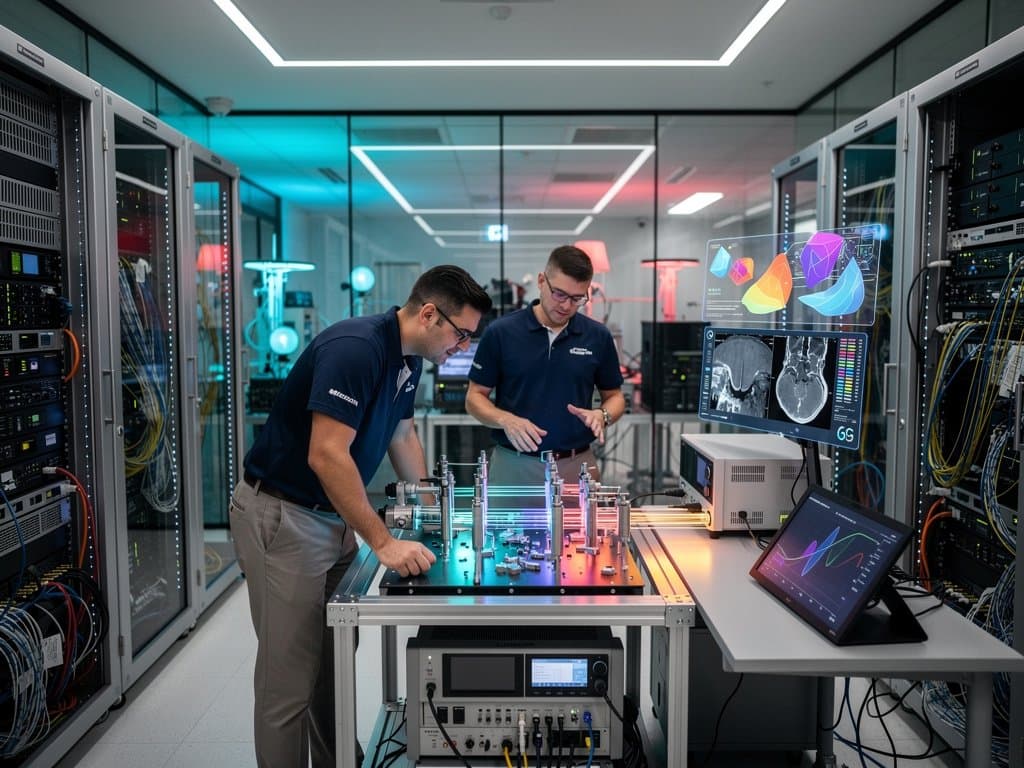
- NIST any-wavelength lasers tune UV-IR for 1 Tbps 6G speeds.
- Cloud WDM scales 512 channels, cutting costs 30-50%.
- Dye-free spectroscopy at 980 nm boosts OCT resolution 1 micron.
The National Institute of Standards and Technology (NIST) unveiled any-wavelength lasers that tune precisely from ultraviolet to infrared. Engineers in Gaithersburg developed this photonics breakthrough for 6G networks, cloud data centers, and precision medicine. Quantum dots enable emission control without moving parts. NIST detailed the foundational technology in their 2021 announcement.
How NIST Any-Wavelength Lasers Work
NIST any-wavelength lasers use electrically pumped quantum dots in photonic crystal cavities. Engineers adjust the dot's bandgap with voltage to shift emission across UV to IR. Indium arsenide dots on gallium arsenide substrates couple into optical fibers at 90% efficiency, per NIST tests.
Devices achieve linewidths below 1 nm and milliwatt output power. These specs integrate with silicon photonics chips. The lasers replace copper interconnects in data centers. NIST applies optical frequency comb expertise for dynamic tuning.
NIST Any-Wavelength Lasers Accelerate 6G to 1 Tbps
6G requires terahertz bands above 100 GHz for 1 terabit-per-second speeds. NIST any-wavelength lasers generate carrier waves at 0.1-1 mm wavelengths. This design avoids atmospheric absorption peaks. NIST launched 6G standards publications in May 2024 to support such innovations.
Base stations deploy dynamic beamforming in massive MIMO arrays. Verizon pursues photonics for mmWave backhaul. AT&T targets microsecond latency for AR and holography apps. Terabit speeds boost investor interest in telecom infrastructure.
- 6G Band: 100-300 GHz · Wavelength: 1-3 mm · NIST Laser Advantage: Avoids water vapor loss
- 6G Band: 300 GHz-1 THz · Wavelength: 0.3-1 mm · NIST Laser Advantage: Single-mode stability
- 6G Band: >1 THz · Wavelength: <0.3 mm · NIST Laser Advantage: 80% quantum efficiency
Ericsson projects 6G market growth to $964 billion USD by 2030, per their June 2024 report. Qualcomm invests $4.2 billion USD in photonics R&D for 2024.
Cloud Data Centers Save 40% with NIST Lasers
Cloud data centers consume 200 TWh annually on interconnects, according to the International Energy Agency's 2023 data. NIST any-wavelength lasers support wavelength-division multiplexing (WDM) across 512 channels. Intel embeds tunable emitters in silicon photonics platforms. GlobalFoundries manufactures them at 45 nm nodes.
Google Cloud installs optical switches in TPU v5 pods. Costs fall 30-50% compared to electro-optic methods, per Google Cloud's 2024 infrastructure update. Hyperscalers like AWS handle 10 exabytes daily. Tunable lasers push C-band fiber capacity to 100 Tbps per strand.
Amazon reported $25.1 billion USD in AWS revenue for Q1 2024, per their earnings call. Photonics reduces latency by 70% for AI training workloads. Microsoft Azure forecasts photonics to cut data center energy use by 40% by 2027.
Precision Medicine Gets Dye-Free Scans
NIST any-wavelength lasers enable biomarker spectroscopy without fluorescent dyes. Surgeons tune to 980 nm to bypass hemoglobin absorption. Optical coherence tomography (OCT) reaches 1 micron resolution for cancer detection.
Raman spectroscopy covers 500-2000 cm⁻¹ shifts in drug discovery. Pfizer employs stable sources to accelerate clinical trials, per their 2024 R&D report. FDA-cleared OCT devices use NIST calibration standards.
The global precision medicine market hits $110 billion USD in 2024, per Grand View Research. Tunable lasers drive 15% CAGR through 2030.
Photonics Investments Amid Crypto Volatility
Bitcoin trades at $75,298 USD, down 2.3%, per CoinGecko data. Ethereum stands at $2,324.42 USD, down 3.6%. The Fear & Greed Index registers 27, per alternative.me, indicating extreme fear.
Cloud platforms run Ethereum layer-2 rollups and Solana validators on AWS. NIST lasers increase DeFi throughput 10x to 100,000 TPS. Photonics firms like Lumentum (LITE) report 25% margins.
- Asset: BTC · Price (USD): 75,298 · 24h Change: -2.3%
- Asset: ETH · Price (USD): 2,324.42 · 24h Change: -3.6%
- Asset: XRP · Price (USD): 1.43 · 24h Change: -3.0%
- Asset: BNB · Price (USD): 622.34 · 24h Change: -3.4%
Coherent Corp. (COHR) stock climbed 18% YTD on photonics demand, per Yahoo Finance. Lumentum Holdings projects 20% revenue growth in 2025. Cloud optics forecast 5x bandwidth value increase by 2030, per LightCounting market analysis.
Frequently Asked Questions
What are NIST any-wavelength lasers?
Electrically tuned quantum dots in microcavities emit stable light from UV to IR without moving parts, per NIST 2021 photonics advances.
How do NIST any-wavelength lasers impact 6G networks?
They generate precise terahertz carriers above 100 GHz, enabling low-latency beamforming. NIST aids standards via 2024 publications.
Why do cloud data centers need NIST any-wavelength lasers?
Scalable WDM optimizes fiber use, reducing latency and costs 30-50% for AWS-hosted blockchain and hyperscale traffic.
How might NIST any-wavelength lasers affect precision medicine?
Dye-free spectroscopy at 980 nm enhances OCT and Raman for cancer detection and drug trials.