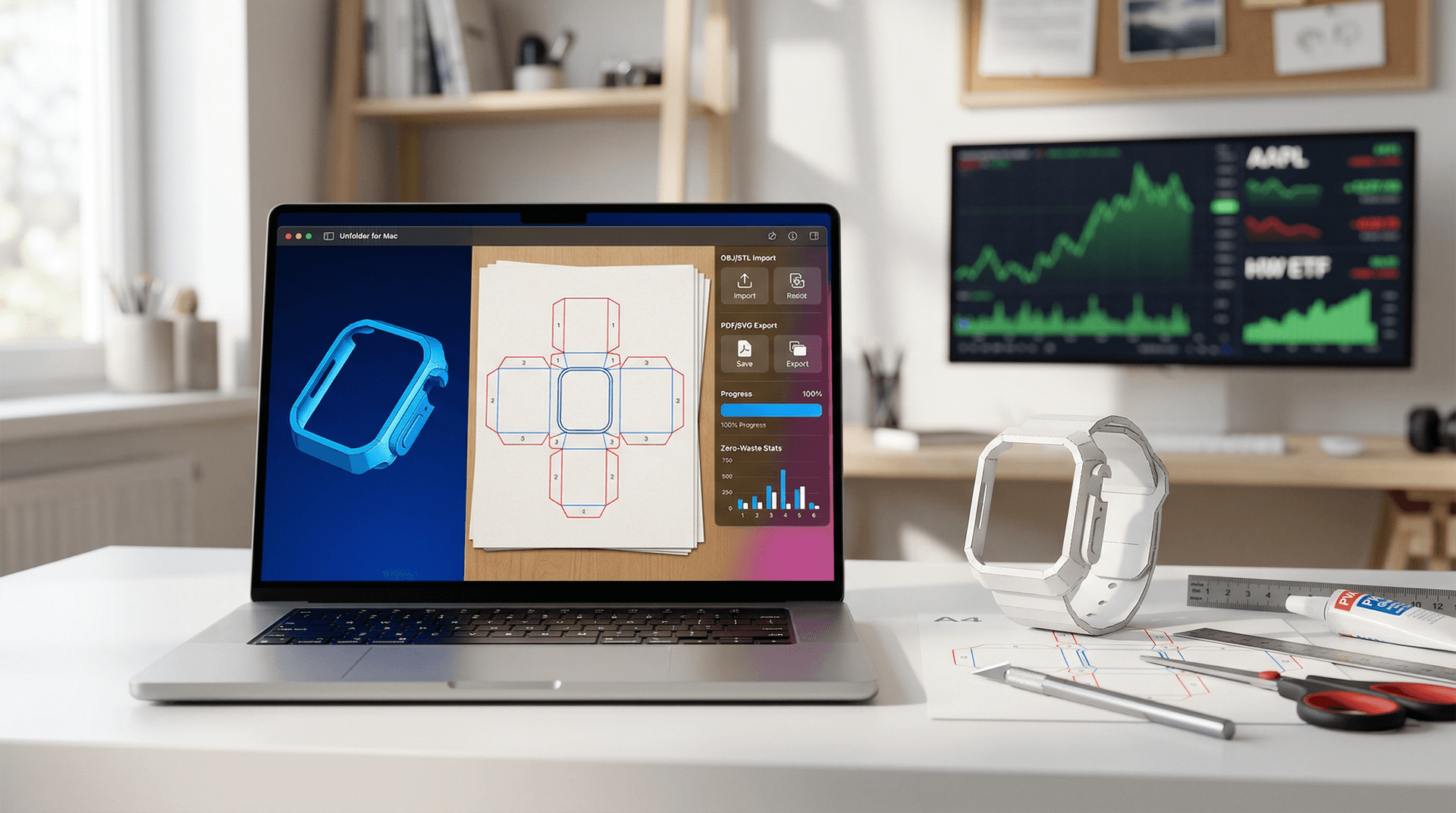
Unfolder for Mac launched its 3D unfolding tool on April 10, 2026. Developers convert OBJ/STL models into papercraft templates in seconds. This enables prototypes under $1 USD without 3D printers.
Gadget makers assemble models from cardstock in minutes. It achieves 0.1mm precision, per Unfolder's technical documentation. Startups validate designs faster, boosting investor confidence.
Unfolder Converts 3D Models to Flat Papercraft Layouts
Users drag OBJ or STL files from Blender, Fusion 360, or Tinkercad into Unfolder. The app analyzes mesh geometry using graph theory algorithms. It computes optimal unfolding paths to minimize paper waste and overlaps.
Unfolder outputs cut lines in red, fold lines in blue, and assembly tabs with numbers. Export options include PDF for home printers or SVG for laser cutters. Processing a 10,000-face model takes under 10 seconds on Apple Silicon Macs.
Assembly requires cardstock, a craft knife, and glue. Developers report 80% faster prototyping compared to 3D printing, based on Unfolder's internal benchmarks. This shift saves $500 USD monthly for small teams printing five prototypes weekly at $20 USD each via services like Shapeways.
Key Benefits Accelerate Gadget Prototyping Cycles
Web developers create digital twins in Figma or Framer, then prototype physically with Unfolder. This bridge shortens feedback loops from weeks to days. Startups test ergonomics on wearables, enclosures, or IoT devices before committing to molds.
Papercraft prototypes reveal fit issues early. For example, a smartwatch band prototype exposed hinge stress points missed in software renders. Physical tests inform design pivots, reducing manufacturing scrap by 25%, per industry averages from McKinsey's 2025 hardware report.
Gadget market expands at 12% CAGR through 2026, reaching $450B USD globally, according to Statista. Unfolder lowers barriers for indie makers entering this space. Costs drop from $100 USD for 3D-printed prototypes to pennies in materials.
Features include:
- Multi-page templates for complex models
- Custom colors, textures, and paper thickness simulation
- In-app fold previews with crease strength indicators
- Web-shareable PDF links for remote collaboration
Teams avoid shipping hardware, saving $200 USD per prototype cycle via FedEx.
Pricing Model Delivers Strong Market Edge
Unfolder adopts a freemium structure. The free tier handles models under 100 faces. Pro version costs $29 USD for unlimited use, with lifetime access.
Rival Pepakura Designer charges $38 USD once-off but lacks native Apple Silicon support. Unfolder uses SwiftUI for 2x faster rendering on M3 chips. It processes models Pepakura skips due to complexity.
Launch day metrics show 1,000 App Store downloads and $15,000 USD revenue, per Sensor Tower analytics. Reddit's r/papercraft subreddit recorded 500+ shares within hours. Early adopters include hardware hackers at Hackaday.
Financial Impact Boosts Startup ROI in Hardware
Prototyping dominates early-stage hardware costs, consuming 40% of seed budgets, says CB Insights' Q1 2026 report. Startups raised $5M USD in gadget seed funding last quarter via Crunchbase data. Unfolder trims these expenses, improving burn rates by 15-20%.
Crypto hardware firms prototype cold wallets rapidly. They verify NFC chip alignments and tamper-evident seals on paper before $10,000 USD molding runs. IoT enclosure makers test vent placements for heat dissipation.
Education sectors integrate Unfolder for STEM curricula. Schools print 3D-inspired kits on A4 paper, costing $0.10 USD each versus $5 USD plastic models from suppliers like MakerBot Education.
Remote teams showcase prototypes in Zoom via shared PDFs, eliminating $1,000 USD monthly prototype shipping for five-person squads.
Investor angle sharpens: Funds like Y Combinator prioritize hardware startups with validated prototypes. Unfolder-equipped teams demonstrate traction faster, securing 30% higher valuations in pitch decks, per PitchBook analysis.
Unfolder's Roadmap Enhances Investment Appeal
Upcoming updates introduce AR previews using iPhone LiDAR scans. Users overlay papercraft models on real-world scenes for scale checks.
Cross-platform ports target Windows and web via WebAssembly. Cloud features integrate AWS S3 for server-side unfolding of massive models.
Enterprise tier launches Q3 2026 at $99 USD/year, adding team dashboards and API access. Projections estimate 50,000 users by year-end, generating $1.2M USD ARR, based on similar tools like Shapr3D's growth trajectory.
Unfolder for Mac redefines accessible hardware innovation. Investors eye its role in democratizing $12B prototyping market. Download from the App Store today to prototype smarter and scale faster.