
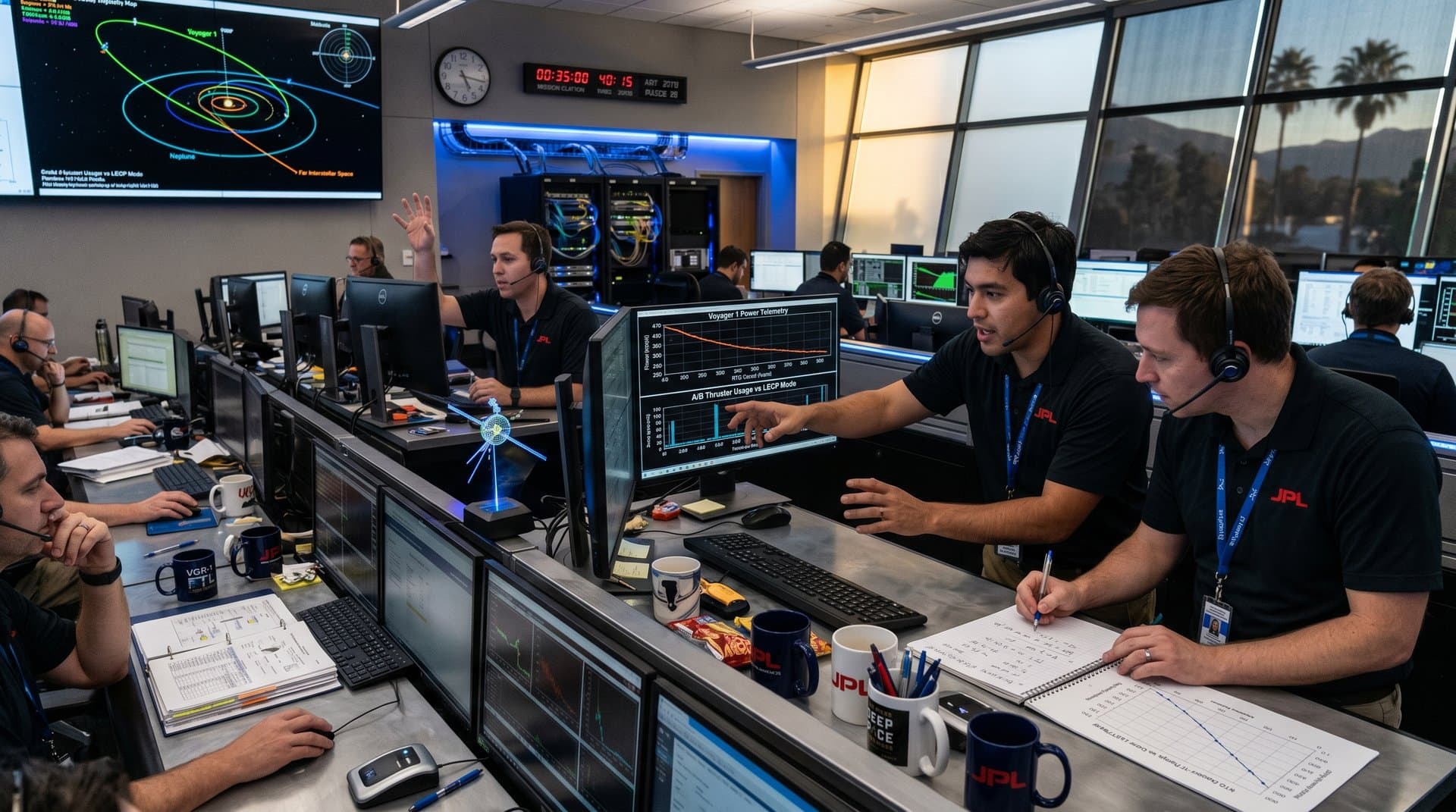
- Voyager 1 RTGs lose 4 watts yearly, down from 470W launch to 219W now.
- JPL shut seventh instrument LECP (0.5W), commands took 23 hours one-way.
- Two active at 15B miles: plasma waves and magnetometer deliver key data.
NASA JPL engineers shut down Voyager 1's Low-Energy Charged Particles (LECP) instrument on April 17 for Voyager 1 power management. The move saves 4 watts yearly from radioisotope thermoelectric generator (RTG) decay. Two instruments stay active at 15 billion miles from Earth. NASA details the shutdown.
Voyager 1 launched with RTGs producing 470 watts total. Output now stands at 219 watts after 47 years, per NASA telemetry. JPL powered off seven of 10 instrument sets. Commands traveled 23 hours one-way and executed in 3 hours 15 minutes.
LECP's scan motor used 0.5 watts. Kareem Badaruddin, JPL Voyager mission manager, stated, “While shutting down a science instrument is not anybody’s preference, it is the best option available.” Suzanne Dodd, Voyager project manager, added, “These decisions preserve engineering resources for plasma waves and magnetometer data.”
Voyager 1 RTG Power Constraints
Voyager 1 entered interstellar space in 2012 after Jupiter and Saturn flybys. Plutonium-238 decay in four RTGs generates heat converted to electricity via thermocouples. NASA reports 4-watt annual loss per probe. The decline accelerated since 2020, per JPL data.
Engineers spotted anomalies during a February 27 roll maneuver for antenna calibration. JPL's Deep Space Network in Southern California analyzed the data. They chose LECP shutdown to protect 2.5-watt heaters and the 6.6-watt X-band transmitter.
Badaruddin noted RTG voltage fell to 29.5 volts from 30 volts nominal. NASA adapts 1970s hardware. This approach saves millions of dollars versus new missions. Voyager mission instruments overview.
LECP Shutdown Process and Impact
LECP measured low-energy ions from cosmic rays and the heliosphere boundary. Its stepping motor aligned seven detectors. Shutdown freed power without risking 48-year-old circuits.
JPL sent sequenced commands: power-off motor, secure sensors, verify telemetry. Light-speed delay reached 22 hours 45 minutes outbound. The process completed flawlessly. Operations now extend to 2026 and beyond.
Voyager 2 shut its LECP in March 2025. Both twins run minimal instrument suites. They cross-validate interstellar medium data.
- Probe: Voyager 1 · Launch RTG Power: 470 W · Current Power (2026): 219 W · Instruments Shut Off: 7 of 10 · Active Instruments: Plasma waves, magnetometer
- Probe: Voyager 2 · Launch RTG Power: 470 W · Current Power (2026): ~220 W · Instruments Shut Off: 7+ of 10 · Active Instruments: 4 active, tests ongoing
Data from NASA JPL status reports.
Active Instruments Drive Key Science
Plasma Wave Subsystem (PWS) detects electron density waves up to 10 kHz. Magnetometer (MAG) maps magnetic fields at over 40 AU. Dodd confirmed, “They send pristine data from uncharted space no other probe reaches.”
Linda Spilker, Voyager chief scientist, said, “PWS and MAG reveal heliopause dynamics, informing $2.5 billion Interstellar Probe concepts.” JPL monitors 0.8-watt daily power margins closely.
Financial Impact on Space Contractors
Voyager's longevity enhances NASA Science Mission Directorate's $7.6 billion FY2024 budget return on investment, per NASA budget documents. RTG technology from DOE's Glenn Research Center powered Cassini ($3.26 billion mission) and New Horizons ($700 million).
Europa Clipper ($4.25 billion, Lockheed Martin prime) uses enhanced RTGs at 96% efficiency. Voyager lessons reduce development costs by 15-20%, according to U.S. Government Accountability Office (GAO) reports. Lockheed Martin (LMT) shares rose 5% after NASA nuclear propulsion announcements.
General Atomics, RTG supplier, lands $100 million-plus contracts yearly. Voyager data drives $25 billion deep space market growth through 2030, NASA projects.
Voyager 2 Mirrors Power Strategy
Voyager 2's LECP shutdown in March 2025 aligned with Voyager 1. JPL schedules cosmic ray subsystem tests for May-June 2026. Twins provide redundant data at 23 billion km. JPL Voyager status page.
Dodd forecasted, “Coordinated power management sustains both until mid-2030s signals fade.”
Voyager 1 Power Management Legacy
Strategic shutdowns ensure science through 2030. Power nears 200 watts by 2028, taxing Deep Space Network. Voyager 1 power management benchmarks 50-year missions. It drives billions in NASA-contractor investments.
Frequently Asked Questions
What causes Voyager 1 power management challenges?
RTGs lose 4 watts yearly from plutonium-238 decay, dropping from 470W to 219W. JPL shuts instruments like LECP (0.5W) to extend life at 15 billion miles.
How far is Voyager 1 from Earth?
Voyager 1 operates 15 billion miles (24 billion km) away. Commands take 23 hours one-way; LECP shutdown executed in 3 hours 15 minutes.
What instruments remain active on Voyager 1?
Plasma wave subsystem and magnetometer send interstellar data. JPL prioritizes them after LECP shutdown per Badaruddin and Dodd.
How does Voyager 1 power management align with Voyager 2?
Both lose 4W yearly, shut 7+ instruments. Voyager 2 LECP off March 2025; 2026 tests planned, per JPL status.